
Pillar 3 - the 10 daily circuits
each with 8 small habits 'units'
List of the 10 circuits:
Circuit 1. Outdoor movements.
Circuit 2. Indoor movements
Circuit 3. Functional integrated movements
Circuit 4. Deskercise Upper body movements
Circuit 5. Deskercise Lower body movements
Circuit 6. Rotations
Circuit 7.Yoga poses
Circuit 8. Relaxation unwinding
Circuit 9. Hydration & Nutrition
Circuit 10. Daily Task list:
- 1xA = deep work ( most urgent important tasks)-
- 3xB = medium - 30 minute each - tasks -
- 5xC = simple - 5 minute tasks -
- 8xD = 2 minute each- development/journal tasks.
Completing all habits results in:
80 new habits per day, which adds up to
- 400 habits per week and
- 1,600 per month.
This structured self-care system aims to rejuvenate employees & CEO throughout the day.
Ensuring the employee & CEO leave work feeling energized and prepared for personal and professional success.
The approach is inclusive and adaptable, making it accessible to everyone.

Introduction to 10 Daily Circuits:
Structured self-care.
A holistic approach to well-being at work—designed to help employees recharge throughout the day.
By integrating small, intentional practices across key life areas, the 10 Daily Circuits foster sustained energy, focus, and personal growth.
Key elements:
Time Management • Movement • Mindfulness • Skill Development • Creativity • Wealth & Personal Growth • Hydration & Nutrition
Goal
These circuits encourage regular, replenishing breaks—so employees leave the office feeling refreshed, motivated, and accomplished, with practical tools to support long-term well-being and success.
The motivational scores
Each circuit is inclusive and doable for every team member.
- 8 units (tiny habits) per circuit
- 10 circuits = 80 micro-habits per day
- Weekly total: 5 × 80 = 400 habits
- Monthly total: 400 × 4 = 1,600 habits
From 0 to 1,600 small, powerful actions each month—building momentum, one tiny habit at a time.

List of the 10 Circuits:
- Circuit 1. Outdoor movements
- Circuit 2. Indoor movements
- Circuit 3. Functional integrated movements
- Circuit 4. Deskercise Upper body movements
- Circuit 5. Deskercise Lower body movements
- Circuit 6. Rotations
- Circuit 7.Yoga
- Circuit 8. Relaxation unwinding
- Circuit 9. Hydration & Nutrition
- Circuit 10. Daily Tasks
10 Circuits details
Circuit 1. Outdoor movements:
- 8:00-8:20 AM - 8 units
Warming up. Slowjogging 2-4-8 minutes
- Infinity jog or walk > clockwise, anti clockwise,
- Infinity jog or walk > backwards (Coordination, cardio, agility)
- Rotations: Hips circles 2-4-8L<>2-4-8 R (Coordination, agility, flexibility)
- Skippings: 1x8 or 2x8 or 3x8 (Cardio)
- Jumping jacks: 1x8 or 2x8 or 3x8 (Strength & cardio)
- Stand on one leg. Count seconds. L<>R (Balance)
- Arm swings 8 different directions: each direction 2-4-8x (Flexibility).
- Stretch > Back of the leg - hamstring- stretching*
- Calf stretches: *serie of 8 stretches each hold 2-4 seconds
Circuit 2. Indoor movements
- 8:20-8:30 AM - 8 units
- Swiss ball: front-back 2-4-8x (Core & stretching)
- Rebounding 8-16-24 jumps (Multi functions)
- Walk over straight line (Balance)
- Planking each side: front, l+r side+ back> 8-16-24 seconds (Strength)
- Wall-sit with arm movements 8x8 (Strength)
- Weaving trough cones with football (Agility, cardio, coordination)
- Leg rotations back side 2-4-8x. (Rotation & strenght)
- Pull ups each millimetre is good. Just hang: stretching back. (Strength & stretching)
Circuit 3. Functional integrated movements
- Any time frame - 8 units
- Stamina & strength. Stairs up <> Stairs down
- Conscious food prep & planning: soak and rinse (later in a pomodoro) your own salad. Cut fruits. *Soak walnuts.
- Nature connection & recycle. Watering office plants with the water from your salad soak*, (*not give this water to plants)
- Hydration. Fill water container from the filter and re-fill your personal water bottle 2-4-8
- Conscious food prep. Making your breakfast smoothie bowl. Rinse blender give rinse water to plants
- Consciousness. Dust/clean: your pc, your phone, your desk with calm slow movements.
- Hand writing. Hand write goals combined with study calligraphy at the same time.
- Hand written journals: 1. gratitude. 2. Reflection. 3. Self development. 4. Corporate skill journal
Circuit 4. Deskercise Upper body movements
- Late morning - 8 units
- Flexibility. Neck: bend sides L<> R x 2-4-8
- Flexibility. Neck: bend front <> back x 2-4-8
- Flexibility. Neck turn L<> R x 2-4-8
- Flexibility. Shoulders - Arms up <> down - sideways x 2-4-8 Shoulders - Arms up <> down - front x 2-4-8
- Cardio. Boxing in sit 3 x 2-4-8
- Stretch. Fingers & wrists stretch: flex <> bend x 2-4-8
- Stretch. Spine > side Left <> Right x 2-4-8
- Flexibility. Spine > back <> front x 2-4-8 see
Circuit 5. Deskercise Lower body movements
- Late morning - 8 units
Cardio - Strength - Flexibility - Balance
- Squats behind and hold chair: 2-4-8x
- Plank front lean on desk w/ straight arms look down: 2-4-8 sec + pushups: 2-4-8x
- Hold sides armchair straight arms: 2-4-8 sec + push-ups: 2-4-8 x
- Plank back > hold desk w/ straight arms look up: 2-4-8 sec & dips: 2-4-8 x
- Leg raises. Stand next to and hold the chair: Leg raises backwards: 2-4-8 x + 2-4-8 sec hold.
- Leg raises side ways: 2-4-8 x + 2-4-8 sec hold
- Balance: Stand on one leg: count Stand on one leg>eyes closed >count. L<>R
- Cardio: skipping behind chair 3 x 2-4-8 sec
Circuit 6 - Rotations
- 8 units After deep work - before lunch- before & after meeting - unwinding time - 8 units
2-4-8 x clockwise & 2-4-8 x anti clockwise
- Rotation head - neck
- Rotation of the eyes
- Rotation arms & fingers
- Rotation shoulders
- Rotation trunk
- Rotation hips
- Rotation Ankles
- Rotation whole body
Circuit 7.Yoga
- 8 units - Before or / and After meeting and / or anytime
- Breathing* see at circuit 8
- Dancer pose *
- Warrior pose *
- Tree pose
- Sun salution
- Camel pose
- Child's pose
- Cat pose
- Cow pose
Circuit 8. Relaxation unwinding
- 8 units - Last hour of the working day
- Deep breathing*
- PMR (Progressive muscle relaxation)
- Body scan
- Relax mind. Think beach, river, forrest and smile
- Self talk. Say 2 nice things to yourself in silence
- Mindfullness - be a moment in the now
- Letting go - of what is occupying you
- Tai chi or yoga flow from selected YouTube video's
*Core Yoga Breathing Rhythms & Techniques:
- Box Breathing (Sama Pranayama): Inhale 4, hold 4, exhale 4, hold 4.
- 4-7-8 Breathing (Relaxation Breath): Inhale 4, hold 7, exhale 8 (often through the mouth).
- 1:2 Breathing (Soothe Nerveous System): Inhale for 4, exhale for 8 to activate the parasympathetic nervous system.
- Three-Part Breath: Inhale deeply into the belly, then ribcage, then upper chest, followed by a slow, reversed exhalation (belly-ribs-chest).
- Viloma Pranayama (Interrupted Breath): Inhale in three steps with short pauses, or exhale in three steps with pauses.
Circuit 9. Hydration & Nutrition
- 8 units - Spreaded over the day
Vegan raw super food cuisine
- Detox drink with activated charcoal (@home)
- Electrolyte water 2-4-8 cups (over the day)
- VitC & MSM lemonade (between circuits 1+2)
- Wholefood: Fruit - Smoothie Bowl
- Comfort drinks & Herbal tea's (over the day)
- Brain booster milkshake vegan (after deep work)
- Lunch: Rainbow Salad, hummus, pesto, avocado soups, sushi (13:10-13:40)
- Energy snacks (last hours)
Circuit 10. Daily Schedule - Structure - Winning Routines
- 8 units - over the day
- Morning warm up. 8:00-9:00 Morning warm up block
- High priority 1A task. 9:00-11-00 1xA - Deep work
- Medium priority 3B tasks 11.30-13:00 3xB-tasks
- Low priority easy 5C tasks 14.00 15:00 5xC: 5 minutes each
- Prep for meeting task. 1D Skill corporate & Journal - 20 minutes
- Meeting structured with clear agenda and expectations focused on outcomes 15:00-16:00
- Unwinding hour. 16:00-16:30: D2: wealth creation - D3: Personal development. D4 Creative creation.
- Ciruit 8 relaxation technique
The Oasis Office approach includes:
1. Pomodoro-inspired 5-minute breaks every half hour for hydration and rejuvenation.
2. Habit building
a. Atomic Habits: Atomic Habits: An Easy & proven Way to Build Good Habits & Break Bad Ones
b. Tiny Habits to make exercises easy and consistent. Focuses on creating small, easy-to-implement habits that can lead to significant long-term changes in behavior
Implementation
To prevent overwhelm we are building / implementating these new office habbits gradually.
For example first week a 2 minute slowjogging to week 2 a 4 minute slowjogging. In week 3, we'll explore expanding these practices, such as increasing the duration of activities like 8 minutes jogging.


Pillar 3 Contains of 10 daily circuits
which are doable for every office member
Each circuit contains 8 units (tiny habits) If you manage to do all the units you have gained 800 units that day.
From 0 to 800 new tiny habits.
List of the 10 Circuits:
10 Circuits listed:
8:00-8:20 AM
8 units
- Warming up. Slowjogging 2-4-8 minutes
- Coordination. Infinity jog or walk >clockwise, anti clockwise, backwards
- Rotations: Hips, spine and shoulders 2-4-8L<>2-4-8 R
- Cardio. Skippings: 1x8 or 2x8 or 3x8
- Strength & cardio. Jumping jacks: 1x8 or 2x8 or 3x8
- Strength. Planking each side 8-16-24 seconds
- Strength. Wall-sit with arm movements 8x8
- Stretching. Back, legs, calves & hip flexors: serie of 8 stretches each hold 2-4 seconds
8:20-8:30 AM
8 units
- Core & stretching. Swiss ball: front-back 2-4-8x
- Multi functions. Rebounding 8-16-24 jumps
- Balance. Walk over straight line
- Balance. Stand on one leg. Count seconds. L<>R
- Flexibility. Arm swings 8 different directions: each direction 2-4-8x
- Agility. Weaving trough cones with football
- Rotation strenght. Leg rotations back side 2-4-8x
- Strength & stretching. Pull ups each millimetre is good. Just hang: stretching back
Circuit 3. Functional integrated movements
Any time frame
8 units
- Stamina & strength. Stairs up <> Stairs down
- Conscious food prep & planning. Wash your salad. Cut fruits. Soak walnuts.
- Nature connection & recycle. Watering office plants with the water from your salad soak.
- Hydration. Fill water container from the filter and re-fill your personal water bottle 2-4-8
- Conscious food prep. Making your breakfast smoothie bowl. Rinse blender give rinse water to plants
- Consciousness and humble. Dust/clean: your pc, your phone, your desk
- Hand written goals with study calligraphy at the same time. on a paper & time schedule
- Hydration & self care. Make your drinks, salad lunch.
Circuit 4. Deskercise Upper body movements
Late morning
8 units
- Flexibility. Neck: bend sides L<> R x 2-4-8
- Flexibility. Neck: bend front <> back x 2-4-8
- Flexibility. Neck turn L<> R x 2-4-8
- Flexibility. Shoulders - Arms up <> down - sideways x 2-4-8 Shoulders - Arms up <> down - front x 2-4-8
- Cardio. Boxing in sit 3 x 2-4-8
- Stretch. Fingers & wrists stretch: flex <> bend x 2-4-8
- Stretch. Spine > side Left <> Right x 2-4-8
- Flexibility. Spine > back <> front x 2-4-8
Circuit 5. Deskercise Lower body movements
Late morning
8 units
- Strenght. Squats behind and hold chair: 2-4-8x
- Strenght. Plank front lean on desk w/ straight arms look down: 2-4-8 sec + pushups: 2-4-8x
- Strenght. Hold sides armchair straight arms: 2-4-8 sec + push-ups: 2-4-8 x
- Strength: Plank back > hold desk w/ straight arms look up: 2-4-8 sec & dips: 2-4-8 x
- Strength: Leg raises. Stand next to and hold the chair: Leg raises backwards: 2-4-8 x + 2-4-8 sec hold. Leg raises side ways: 2-4-8 x + 2-4-8 sec hold
- Balance: Stand on one leg: count Stand on one leg>eyes closed >count. L<>R
- Cardio: skipping behind chair 3 x 2-4-8 sec
8 units
Before meeting
- Rotation head - neck
- Rotation of the eyes
- Rotation arms & fingers
- Rotation shoulders
- Rotation trunk
- Rotation hips
- Rotation Ankles
- Rotation whole body
8 units
Before or / and After meeting and / or anytime
- Choose pose from the yoga poster
- Choose pose from the yoga poster
- Choose pose from the yoga poster
- Choose pose from the yoga poster
- Choose pose from the yoga poster
- Choose pose from the yoga poster
- Choose pose from the yoga poster
- Choose pose from the yoga poster
Circuit 8. Relaxation unwinding
8 units
Last hour of the working day
- Deep breathing 2-2-2-2 or 4-4-4-4 or 8-9-8-8 seconds: inhale-hold breath in (oxygen can travel to cells)-exhale-nothing (do a body scan or just relax)
- PMR Progressive muscle relaxation
- Bodyscan
- Relax mind. Think beach and smile
- Self talk. Say 2 nice things to yourself in silence
- Mindfullness - be a moment in the now
- Letting go of what is occupying you
- Planning hand writtenyour goals for tomorrow.
Circuit 9. Hydration & Nutrition
8 units
Vegan raw super food cuisine
- Detox drink with activated charcoal (@home)
- Electrolyte water 2-4-8 cups (over the day)
- VitC & MSM lemonade (between circuits 1+2)
- Wholefood: Fruit - Smoothie Bowl
- Comfort drinks & Herbal tea's (over the day)
- Brain booster milkshake vegan (after deep work)
- Lunch: Rainbow Salad, hummus, pesto, avocado soups, sushi (13:10-13:40)
- Energy snacks (last hours)
8 units
- Morning warm up. 8:00-9:00 Morning warm up block
- High priority task. 9:00-11-00 1xA - Deep work
- Medium priority tasks 11.30-13:00 3xB-tasks
- Lunch. 13:00 14:00
- Low priority easy tasks 14.00 15:00 5x: 5 minutes each
- Prep for meeting task. 1D-- 20 minutes: Prepping for the meeting
- Meeting 6. 15:00-16:00
- Unwind ingredients hour. 16:00-16:30: D2: wealth creation - D3: Personal development. E. Evaluation see Circuit 8.
Pillar 3: Embracing Movement and Nurturing Healthy Habits
Discover the transformative power of Pillar 3 in the Oasis Office concept: Movement.
We integrate time-management techniques like the Pomodoro Method to foster a balanced workday, incorporating breaks for hydration, refreshment, and exercise.
The Oasis Office approach includes:
1. Pomodoro-inspired 5-minute breaks every half hour for hydration and rejuvenation.
2. Habit building.
a. Atomic Habits: Atomic Habits: An Easy & proven Way to Build Good Habits & Break Bad Ones
b. Tiny Habits to make exercises easy and consistent. Focuses on creating small, easy-to-implement habits that can lead to significant long-term changes in behavior
Implementation
To prevent overwhelm we are building / implementating these new office habbits gradually.

Motivation for the 10 circuits
- If one spend over 7 hours per day in a seated or lying down position (excluding time spent sleeping), one is considered to be sedentary/stagnated.
- If one consumes DAILY: sugar, coffees, fast food, starches/carbs, dairy, meat, soda's one becomes slow/stagnant.
If one lives a stagnant lifestyle, one have a higher chance of being:
- lack of energy,
- drag self out of bed,
- coffee and sugar addiction,
- fast food victim,
- overweight,
- developing type 2 diabetes or
- high BP
- heart disease,
- weakness,
- joint pains-stifness,
- brain fogs,
- mood swings,
- jittery, restless,
- sleeping problems,
- stress sensitive,
- experiencing depression and anxiety.
How to break this circles
- In Elevate Sustainable Workspace, we prioritize low-impact, full-body exercises that can be easily integrated into daily routines.
- These exercises are designed to be both effective and accessible, ensuring that everyone, regardless of fitness level, can participate and benefit from regular physical activity.
- The exercises are performed in short intervals throughout the day, allowing employees to maintain focus on their work while still prioritizing their physical well-being.
- By breaking up the workout into manageable segments, we aim to make physical activity more approachable and less intimidating, encouraging consistent engagement and promoting a healthier work environment.
The Oasis Office goals:
is to create a workplace culture that
- Values and supports the physical- and mental health of employees
- Recognizing that regular exercise not only benefits individual well-being but also contributes to increased productivity, reduced stress, and a more positive work atmosphere.
By emphasizing the physical activities, day structure, mindfull integrated relaxation, personal development within the Oasis, the program is providing employees with the tools, resources, and support they need to make movement and exercise a part of their daily work lives, ultimately enhancing their health, happiness, and professional performance
Motivation of selected movements:
- Slow Jogging: Encouraging gentle, low-impact cardiovascular exercise promotes heart health and can boost energy levels throughout the day
- Stairs: Evidence is piling up that the simple act of climbing stairs – and not even that many stairs – can significantly improve your heart health and longevity
- Flexibility: Prevent stiffness, and reduce the risk of injury
- Balance: Balance-focused activities contribute to core strength, stability, and overall body awareness
- Relaxation: Practicing relaxation techniques and deep breathing exercises aids in stress management, mental clarity, and overall well-being
- Cardio: Incorporating cardiovascular activities helps improve endurance, overall fitness, and mental clarity
- Strength: Encouraging strength-based exercises can enhance muscle tone, posture, and overall physical resilience
- Deskercise: Providing desk-based exercises enables employees to integrate movement into their work routine, reducing sedentary time and promoting muscle engagement
- Rotations: The rotational movement pattern plays a key role in generating force when moving and training at high intensity. However, it is often the weakest link and when this weakness is exposed it can cause muscle spasm, pain and injury to the supporting structures in our body. Building strength and stability in rotational movement patterns will make the body more robust and helps to perform at a higher level.
- Mindfulness in Movement: Promoting mindful movement encourages employees to cultivate awareness of their body and mind while engaging in physical activities.
- Unwinding and Relaxation exercises
- Health menu that tick all the boxes. Delicious. Vitamins. Healthy fats. Phytonutrients. Vegan complete protein profile. Sugar and coffee replacers. Organic.
Benefits
1. Boosts energy levels: Exercise increases blood flow, delivering oxygen and nutrients to your muscles, enhancing energy production and fighting fatigue throughout the day.
2. Enhances focus: Physical activity stimulates the release of brain-derived neurotrophic factors (BDNF), a protein that supports cognitive function and concentration.
3. Reduces stress: Exercise releases endorphins, promoting relaxation and alleviating tension.
4.Energy level is strongest in the morning. This approach aims to make the most of your energy levels at the start of the day
5. Minimize procrastination: Group Movement for Enhanced Focus and Accountability. At Holistic Oasis Office, collective movement fosters motivation, improves focus, and nurtures positive reinforcement. By exercising together, employees stay committed to their fitness routines and work tasks while building camaraderie. Structured movement sessions promote efficient time management and reduced procrastination for optimal productivity.
6. Release of feel good hormones*. When you complete a task early in the morning, it can lead to the release of several beneficial hormones, including:
*Dopamine: Known as the "feel-good hormone," dopamine is released when we experience pleasure, satisfaction, and accomplishment.
*Endorphins: These hormones act as natural painkillers and mood elevators, producing feelings of happiness and well-being. Accomplishing a task can lead to an endorphin release, contributing to a positive mindset and increased productivity.
*Serotonin: Serotonin is associated with feelings of contentment, calmness, and confidence. Achieving a goal or completing a task early in the day can increase serotonin levels, fostering a sense of satisfaction and self-assurance.
By taking advantage of these natural hormonal responses, completing tasks early in the morning can set a positive tone for the rest of your day, enhancing your overall well-being, and promoting productivit.


Total exercises
https://www.healthline.com/health/fitness/what-muscles-do-planks-work
https://www.cosmopolitan.com/uk/body/fitness-workouts/a24569/skipping-workout-benefits/
https://www.menshealth.com/fitness/a19546586/jumping-rope-workout-circuit-exercises/
Jumping jacks
are an efficient total-body workout that you can do almost anywhere. This exercise is part of what's called plyometrics, or jump training. Plyometrics* is a combination of aerobic exercise and resistance work. This type of exercise works your heart, lungs, and muscles at the same time.
Jump training may be good for bone health, too. In one study, rats were put on a jumping exercise regimen for eight weeks (200 jumps per week with 40 jumps per day for five days
*Plyometrics is a form of exercise that uses powerful, rapid movements to help increase speed, power, and strength. Although people may associate plyometrics training with sports-specific athletic performance, nearly anyone can use plyometrics as a form of exercise to help improve their overall strength and power.
Rebounding
is a low impact, total body workout that enhances your cardiovascular health and aids in weight loss. It boosts metabolism, burns calories, and strengthens the heart muscle
- Relax. Just a few minutes of bouncing at the end of your day can make a big difference to your health and happiness. Light bouncing can increase blood flow to underused muscles and loosen and release overused ones, plus it helps the body release endorphins (your brain’s natural calming aid, they make us feel good). Being in your body and getting out of the business in your head comes naturally as you bounce, and it can help clear your mind and decrease tension.”
- Low impact. Research reveals that exercising on a trampoline reduces approximately 80% of the force exerted on your joints compared to walking/running on pavement.
- Lymphe function. Rebounding causes the valves in the lymphatic system to open and close simultaneously, increasing lymph flow as much as 15x. This boosts immunity, removes toxins, and help slow down the aging process. Muscle contraction and sweating move lymph fluid. Muscle contraction moves lymph fluid through the lymphatic system, Dr. Maclellan explains, so any type of exercise that causes muscle contraction can benefit the lymphatic system, including rebounding.Dec
Wallsit with arm movements
Predominantly working the quadriceps - four muscles found at the front of the thigh that help with knee stability, and everyday functionality like walking, getting up from a seated position, and climbing stairs, wall sits can also help to increase your endurance, balance, core strength and lower back strength.
What is a wall sit good for?
- with arm circles
- with arm raises
Planking
https://www.healthline.com/health/fitness/what-muscles-do-planks-work
Rope skipping
"Skipping is an entire body workout. Your legs and calves will feel the burn but your arms, shoulders and core will tighten up, too," Forget separate leg and upper body days, a regular jump rope session will work muscles all over your body – for example, you wouldn't think it would work your ab muscles, but skipping forces you to engage your core to stabilise the body. "Skipping is an entire body workout. Your legs and calves will feel the burn but your arms, shoulders and core will tighten up, too," explains Yanar Alkayat, a level 3 personal trainer.
https://www.cosmopolitan.com/uk/body/fitness-workouts/a24569/skipping-workout-benefits/
A widely cited study found that jumping rope is one of the most effective cardio exercises out there—and it can whip you into shape with just a few minutes a day of skipping.
https://www.menshealth.com/fitness/a19546586/jumping-rope-workout-circuit-exercises/
Slow jogging
Slow jogging offers several benefits, including improved cardiovascular endurance, reduced risk of injury, and enhanced recovery. It also helps build a strong aerobic base, making it suitable for both beginners and experienced runners.
When you run at a leisurely, comfortable pace, you're far less likely to injure yourself. This is because you're going easier on your joints, muscles, and connective tissues, while also strengthening your lower body muscles. Slow jogging benefits an all-round workout of your lower body muscular systems.
https://www.lesmills.com/us/fit-planet/fitness/slow-running/
Cardio
What is cardio?
“Cardio” comes from the Greek word “kardía,” which means heart. Simply put, exercise typically counts as cardio if it involves intentional coordinated physical actions that raise your heart rate for an extended period of time.
A good cardiovascular workout will have you consistently breathing faster than you would while resting. The result: More oxygen in your blood for your heart to pump to the rest of your body.
You’ll also hear cardio referred to as “aerobic exercise.” The term emphasizes the enhanced movement and utilization of oxygen for energy production when you’re engaged in a cardiovascular workout.
While not an exhaustive list, all of the activities below fall into the category of cardiovascular exercise:
Recommendations for Adults
- Get at least 150 minutes per week of moderate-intensity aerobic activity or 75 minutes per week of vigorous aerobic activity, or a combination of both, preferably spread throughout the week.
- Add moderate- to high-intensity muscle-strengthening activity (such as resistance or weights) on at least 2 days per week.
- Spend less time sitting. Even light-intensity activity can offset some of the risks of being sedentary.
- Gain even more benefits by being active at least 300 minutes (5 hours) per week.
There are several benefits to performing cardio exercises early in the morning. Here are some reasons why:
**Boosts Metabolism**: Morning cardio helps kick-start your metabolism for the day, helping your body burn more calories and fat even at rest.
**Hormone Regulation**: Early morning workouts can regulate hormones like cortisol, which can help manage stress and improve overall health.
**Higher Energy Levels**: Starting your day with cardio can provide an energy boost that lasts throughout the day, keeping you more alert and focused.
**Consistency**: By scheduling your cardio for the morning, you're less likely to be derailed by unexpected events that can crop up later in the day, making it easier to stick to your routine.
**Improved Mood**: Starting your day with a cardio workout can release endorphins, which can help boost your mood and set a positive tone for the day ahead.
Doing cardio early in the morning, along with stretching and strength exercises, can be an incredibly beneficial routine for your overall health and well-being.
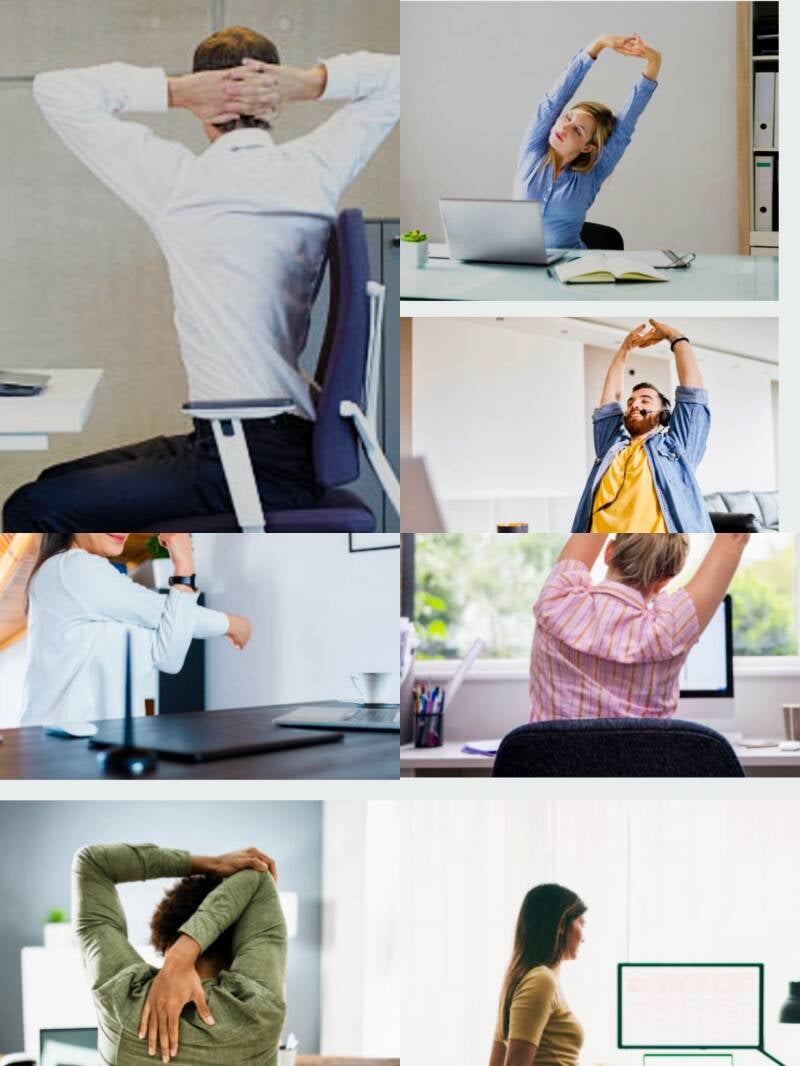
Deskercise
Deskercise” is a new term that defines exercises that can be performed throughout the workday while working on the desk. A growing pool of evidence reveals that deskercise is a realistic, accessible, and buildable option to counteract the odds of a secondary job.
Such exercises are highly effective in relieving stress, boosting energy, increasing flexibility and range of motion, and improving overall productivity.
Prolonged sitting can lead to tight leg muscles, particu larly in the hamstrings, and stiff joints. The exercises in this guide will help relieve muscle tension and joint stiffness and increase flexibility. Deskercise, or exercises you can do sitting at a desk, is not just for people to do at work.
Just small changes can make a huge difference to your activity levels, and the benefits of exercise are undeniable. Not only does physical activity improve your physical health, but your mental health too – helping you to feel good about yourself and making it easier for you to cope with stress.